Friday, November 8, 2013

Feature Friday - Loving and Healing at Twelve Stone Farm- Jerilyn Skyface Flowers


Howdy Folks,
 
Tucked in the mountains of northern Georgia, not far from Atlanta is a loving, healing place called Twelve Stone Farm. Here among nature, hearts, minds, bodies and lives are healed, encouraged, nurtured, and restarted. Abused, neglected and unwanted horses given new life, love and purpose here, use their refreshed spirits to heal and encourage abused, misunderstood at-risk youths.
Sunny and the horses romp at Twelve Stone Farm
After years of working with youths at children's camps and being the director of a spiritual retreat center, Jerilyn Skyface Flowers felt the heart-tug to do more. She sought guidance in a vision quest and saw the beautiful mountains, and in them a peaceful, welcoming farm. Just weeks after that vision she was contacted by the heirs of a farm, and invited to come.
Chiquita Berry had started Twelve Stone Farm as a place of healing. When Chiquita passed away it was her eldest daughter who connected with Jerilyn. "It was even better than the farm I saw in my vision. It really is Heaven on Earth. I knew I was home."
Jerilyn moved to Twelve Stone Farm 3 years ago and carried on the mission that Chiquita had begun. Building on her foundation, Jerilyn created programs and activities designed to use horses and nature to help at-risk and high-risk children and youth to examine their behavior, and to modify their lifestyles from destructive of themselves and others, to cooperation and contribution and to healthy interaction with family and the community.
Jerilyn and New Spirit
Adults and children alike are welcome to come and, "Heal from the inside out," by experiencing nature and the rebuilding of their hearts and dreams. Here is offered a place for primitive camping retreats for Girl and Boy scout troops, school and church groups and families as well as programs for Horse Rescue, Therapeutic Horseback Riding, mentoring for at-risk children, teaching pioneer and camping skills, and many other activities.
Tipi village at Twelve Stone Farm
Twelve Stone Farm is a non-profit equestrian, and agricultural ranch dedicated to providing a sanctuary where people can come into nature and restart their lives.
Making dreams come true
Visit Twelve Stone's website (HERE) and join them on Facebook (HERE)

Gitty Up ~ Dutch Henry

Thursday, November 7, 2013

My Thoughts on Blanketing Horses


Howdy Folks,
 
One of our Coffee Clutch friends asked me to share my thoughts on blanketing horses. Like many things we do for, with, and to our horses, there are mountains of opinions about, "to blanket or not to blanket." I'm mostly in the "no blanket" camp. I reckon few of our Coffee Clutch friends are surprised by that, my, keeping it truly natural practices and beliefs, are not much of a secret.

But what is wrong with blanketing? I think there could be a lot.

Now before we get all excited with the exceptions as to, "yes but you must blanket when – insert any favorite exception here – because …" I understand and agree, sometimes blankets are necessary and important. I also believe wool coolers are very important after a cold winter ride and a nice, thick winter coat is soaked and matted with sweat. Wool coolers wick away sweat and help a horse cool down nicely. Kessy wore one this Sunday after we had a fun romp. Took only about 20 minutes for her to dry, I removed the cooler, brushed her all nice and fluffy, and she went about her way wearing only her smile and her own winter coat.
Kessy sporting her no-blanket look.
I've heard it said that from about 45 degrees  horses burn calories to cool. Yes, to cool – not warm. So what must be going on when a healthy horse has a blanket strapped on its back on a sunny breezy 50 degree day? Sure we want our coat, I know I do, but we're not built to deal with it like horses.

Horses have multiple layers of hair to deal with all sorts of weather, rain, cold and snow. Each layer has its own job and function. Even with snow laying on their backs, those layers do their job admirably. UNLESS their hair is waited down under a blanket. Did you know a horse with a wet blanket, or even a waterproof blanket with snow laying on it is actually colder than a horse without? I've personally demonstrated this by sliding my hand under a wet, not soaked, blanket and the owner was surprised to feel the cold back. And too many times the old waterproof blankets loose their waterproofing and owners, unaware, are thinking they are helping their horse.

Temperatures under a blanket with air temperatures about 40 or 50 can be over 70, sometimes close to 90. If you blanket, check it yourself. I've done it. So if a horse is using calories to cool at 45 degrees, what's going on under a 70 degree blanket? And how often have you seen horses wearing more than one blanket?!

Wearing a blanket impedes normal winter coat growth, they can't grow those very important layers.

Horses with a natural healthy coat can readily, and healthily, regulate their own body temperature, changing with the temperatures of the day. Hairs stand up and lay down as needed. How can we think we can manage that by taking off and on the blankets? And how do we coordinate that?

Horses have several ways to "warm up" on cold days. They can walk around, this goes hand in hand with natural and healthy housing, they need room to roam, or they can stand out of the wind. But I think they do need the ability to walk around when they want to.

What they do need is a way to get out of the precipitation and wind, just a nice run in where they can come and go as they please.

So, my thoughts on blanketing horses? I think most folks do it for their own thoughts of comfort, not the horses.
Kessy is warm and happy in her natural coat ... I needed my heavy insulated coveralls. And Saturday was looking for a warm lap!
 To sum it up, mostly I'm against blanketing. Everyone has their own opionon and circumstances. But I feel bad for the horses standing out in the sun on 50 degree days wearing a blanket because no one had time to remove it ... And I think our common accepted practice appears to be we over-blanket. But that's just my thoughts.

Gitty Up ~ Dutch Henry

Monday, November 4, 2013

Special Horses, Wonderful People, Beautiful Drive


Special Horses, Wonderful People, Beautiful Drive
Howdy Folks,

Ravishin' Robbie and I set out at seven AM yesterday. I had an appointment to visit Traveller's Rest Equine Elders Santuary for an interview for my Heartbeats column in Trail Blazer. Most of my interviews I do on the phone, but when the stories are about People and Horses Helping Horses and People nearby enough, I like to go visit. I really wanted to meet the horses there too. There is something about a senior horse that really gets me. They have a wholly different kind of spirit, and heart. They've seen a lot, done a lot, endured a lot. And the kindness, understanding and lessons they can share are so special. So touching. I wanted to meet Mike and Chris Smith too, the wonderful folks who devote their lives to giving a loving home to these kind and knowing horses. They are a very kind of special too.
The drive from Appomattox to Spotsylvania VA, mostly up route 15 is a delightful drive. It meanders quietly through good scenery, by many horse and cattle farms, and through several neat little towns. Mrs GPS says it should be a two and a half our drive that always seems to take me nearly four. I've been known to pull over to admire the big beautiful maple tree cloaked magnificently in shimmering red leaves, or oaks decked out in yellow with a hundred foot branch-span.

I'll happily swerve onto the road shoulder to gaze at a beautiful horse. Old barns with dilapidated machinery guarding them are things of beauty to me too, and of course worthy of a pause to soak it in. Black Angus cattle, their coats shimmering in the sunlight can often automatically force my geriatric Tahoe to stop.

Any friend of our Coffee Clutch blog knows almost any bird, from Blue Bird to Carolina Wren can stop me, too. You can ask Kessy that one, but that's a story for another day. So yesterday's Great Blue Heron fishing in a small roadside pond, well that was a no brainer.

We did eventually did arrive at our destination, right on time, right behind our dear friend, Karen Lindely who was meeting us to take the pictures for our story. She does really beautiful work. If you'd like to see some of her things, be sure to "friend" her on Facebook.

We all had a simply marvelous visit. Mike and Chris took us all on a leisurely tour of the property and introduced us to each of the 18 horses living there. Housing for elderly horses is so important, and the paddocks or pastures are large with run-ins so we had nice long walks in the pretty sunshine. They told each horse's story, as much as they knew, and I visited with each one, often doing a bit of my Therapy For Therapy Horses exercises. 
Just hanging out in the sun, and lovin' life
Robbie took notes of our conversations for my story, and Karen had those shutters snapping. We were having so much fun, it was hard to leave. But eventually we had to.

The story of what they do there to help aged horses, and how Mike and Chris help guide other folks with senior horses will be in the Jan/Feb issue of Trail Blazer. Be sure to watch for it. Chris' motto is from Seabiscuit, "Just because a horse has a few bumps and scrapes doesn't mean you give up on it."

Gitty Up ~ Dutch Henry

Friday, November 1, 2013

Feature Friday- Therapy Horses -


Howdy Folks,
 
This story about Therapy Horses was published in Natural Horse Magazine  in the Oct/Nov/Dec issue 2012. In that story I also included some of my "Therapy For Therapy Horses"  exercises. I hope you'll enjoy this story and perhaps find a way you can – Help Therapy Horses Help …

**********************
Hippocrates wrote about the benefits of horseback riding for physical therapy, over 3,000 years ago. Hippo is the Greek word for horse. He actually wrote how a rider's pelvis, legs and feet move in synchronization with a walking horse. Thousands of years later this was proven scientifically.

Equine assisted therapy, or Hippotherapy, is an important, and thankfully, growing form of therapy used to help people of all ages improve and enrich their lives. According to Professional Association of Therapeutic Horsemanship International's (PATH Intl.) website www.pathintl.org  there are over 800 member centers around the globe with an estimated 42,000 student participants, 3,500 instructors 30,000 volunteers annually. And 6,300 equines. There are many others as well, but I wanted to be able to site a few actual numbers. I read once that in the US alone there are over 900 organizations or centers founded to offer equine assisted therapy.
 Kids Love Their Therapy Horses
Equine assisted "physical therapy" is used for everything from spinal cord injuries, to stroke victims, to wounded Veterans and skeletal and muscular diseases in children and adults. But seeing the equine/human connection and the ability of the spirit of the horse to touch lives, many therapists began to experiment. They began to use horses to aid in therapies not only related to physical rehabilitation but mental and behavioral health as well.

Therapy horses are incredibly valuable and helpful in so many different ways and for so many different treatments. More and more therapists are finding new and exciting results with not only physical but mental stress and confusion, too. The spirit of the horse connects with the spirit of the person as she visits with or rides a therapy horse.

Many equine assisted therapy centers seek out certain breeds for their therapy horses. For some it's heavy horses, or drafts. For others Haflingers, Icelandic's or Fjords, for their strength in more compact bodies. Many use their own horses. Still others rely on donated horses; many of these have injuries or ailments that end their previous careers. During interviews I've conducted with therapists and equine assisted therapy center owners I've been told about one horse in 25 can be a therapy horse. I suppose it is the same as, not every person can be a therapist, either. I wonder what that ratio would be.

Those wonderful and giving horses who become therapy horses have the inner will to care more about their rider than they do their own body. More than that, they must be aware of, not only their rider, but the therapist, the leader and sidewalkers. I've heard them called, martyrs, in that they will ignore their own needs, or ailments in favor of taking care of those all around them.
She's doing her job and taking care of 4 people at the same time.
Ever aware of those around them, and those who need their support, these remarkable horses often make sacrifices in their movements and can become out of alignment themselves. This causes them to often walk in ways that may not allow free movement, and causes them to be heavy on their forehand, inverted, dropped at the withers and tight in the hind end. This may begin to affect their temperament and they get retired with the thought they are, burned out, or tired of it. That may be the case, sometimes. I chose to write this article, because I don't believe it is the case all the time. Or even most of the time.
My mare, Kessy, enjoys a little release from the "Poll Wiggle." Lightly place your hand on the poll, wiggle gently. I like to hold the halter as shown so when they release you can help support.
Therapy horses can greatly benefit from a little therapy of their own and remain happily on the job for many years. One important thing many folks do with their therapy horses is to take them on regular trail rides. Trail riding is perhaps the easiest form of therapy for the horse and it is not only terrific for the horse's body in that he will be allowed to walk along freely, and even run, but it is great for his mind, too. Stretch those legs, get the heart pumping and take deep breaths. Some centers have set up regular rotations for volunteers to take their horses on trail rides.
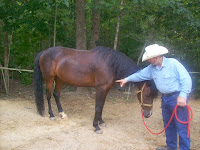
Kessy & me demonstrating the, "Rock Back." With a slight touch ask for the horse to "rock back" off their forehand. This can easily be done while the therapy horse is standing still during therapy sessions and does so much to help their backs.
Hands-on therapy for the horses is important, too. Simple to do exercises to release the poll, soften the inversion muscles and a variety of other tension releasing routines to loosen their stifle and stretch their legs, will help keep a therapy horse happy and in shape. These easy to do exercises should be part of the daily warm up routine. Remember, therapy horses meet new riders who are seeking benefits from the horse all the time. It is different from the horse who has one rider and together they can get into a comfortable and reliable relationship as they explore the world.

Some centers incorporate not only their volunteers and therapists in the therapy-for-therapy-horse sessions, but the students and clients too. A sort of mutual therapy!

I offer free clinics teaching these easy to learn and easy to do exercises to folks at therapeutic riding centers.

The world is a better place because of these wonderful people and horses and we thank them for their tireless efforts. The spirit of the horse touches so many lives, heals so many hearts and builds smiles on thousands of faces. If you have the chance, hug a therapy horse.

Gitty Up
Dutch Henry

Pictures curiosity of Heartland Horse Heroes Appomattox VA and Kessy & me.

Thursday, October 31, 2013

Trick or Treat – How'd That Happen?


Howdy Folks,

Sitting in the barn with Kessy and the critters enjoying our rainy morning Coffee Clutch yesterday, I got to thinking about Halloween. Ravishin' Robbie and I had been chatting about her pumpkin tree, yup, her pumpkin tree. One of Robbie's pumpkin plants had climbed high up a tree, and hanging way up there are three big ol' pumpkins. Her pumpkin tree is a sight to see and made me wonder if the tree was going trick-or-treating as a pumpkin patch, or the pumpkin vine was going as a tree? Neither answered me, and their silence made me wonder, how did trick-or-treat ever get started?

So I asked Mr. Google. That's what our Granddaughter says. She's seven. Mr. Google did offer a few suggestions.

Seems Trick-or-Treat has been around for a long time. A really long time. Some say it can trace its roots all the way to the Celts who lived in an area that is now the UK, Ireland and Northern France, more than 2,000 years ago and celebrated the night of Oct 31, in a festival they called Samhain. They believed the dead could return during Samhain and they gathered for bonfires and feasts. But to ward off the unwelcomed dead they would dress in costumes of animal hide and set out bowls of food to offer treats.
Samhain celebration
By the ninth century Christianity had moved into Celtic lands and began to blend with the ancient pagan beliefs. Around 1,000 AD the church designated Nov 2 as "Old Souls Day" a celebration of the dead. In a modification of the Samhain festival, poor people would visit the homes of wealthy people and offer to pray for the dead relatives in exchange for, "soul cakes." That evolved over time to "souling" when children would go door to door asking for food and money. Children in Scotland would dress up for a night of "guising" and visit homes not offering to pray for the dead, but sing songs in exchange for treats such as milk, fruits or coins.

Then there's also the Guy Fawkes Night celebration – Nov 5 – In 1605 Guy Fawks hatched a plan to blow up Parliament with the King's gunpowder and remove King James I (a Protestant) from power. His Catholic led plot was foiled and Guy Fawks executed. This gave birth to an annual celebration of "BoneFires" where in effigy; the bones of the Pope are burned each Nov 5. By the 19th century children carried Fawks dolls through the streets on Nov 5 asking for "a penny for the Guy."
 
Guy Fawks Day
Along with the early colonists coming to America came versions of these celebrations; including the popular Scottish custom of, "Guising" – children went door to door in disguise seeking gifts and food. In the early 20th century some Scottish immigrates even revived the practice of souling. By the roaring twenties "Halloweening" including pranks had begun to become popular.
It seems the first use of the phrase "Trick-Or-Treat" might have been in an Alberta newspaper in 1927. Almost all pre-1940 uses of the phrase, "trick or treat" come from western US and Canada. The children's magazine, "Jack and Jill" may have been the first to launch national recognition of the term, and practice, when they featured "trick or treating," in their Oct 1947 issue. Trick or treating was featured in the Peanuts comic strip in 1951. Walt Disney featured it in a 1952 comic strip, and by then it so firmly established as an American tradition even the Ozzie and Harriet show was beset by hordes of "trick or treaters" that same year. 
One quarter of all candy sold in the US is purchased for Halloween.
So there ya have it. Mr. Google, The History Channel Blog, and Wikipedia have helped us learn a bit about what has now become our second biggest holiday. 


Gitty Up & TRICK-OR-TREAT ~ Dutch Henry